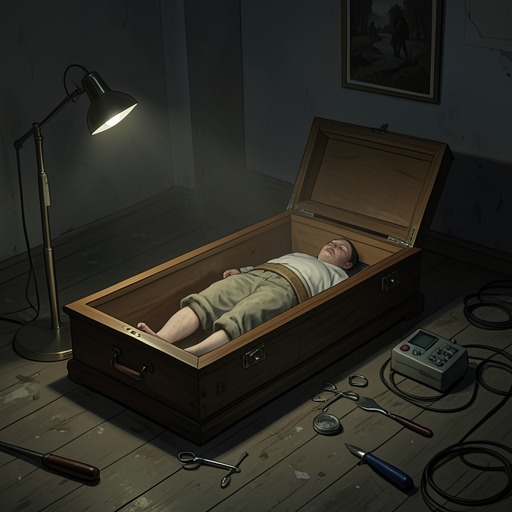
Mercy Brown vampire exhumation
A History of the Vampire in Popular CultureMercy Brown vampire exhumation was a 1892 act of grave disinterment in Exeter, Rhode Island, in which tuberculosis was interpreted as evidence of vampiric attack. The episode shows how an epidemic, uncertain knowledge of the body, family grief, and communal supernatural belief could turn a young woman’s corpse into the alleged source of continuing danger.
Disease and Vampire Panic
During the nineteenth-century New England vampire panic, tuberculosis was spreading rapidly through households. Known as “consumption” because it appeared to consume a victim’s health, the disease was highly contagious, but its transmission was poorly understood. Communities sometimes imagined that a dead family member returned to steal the life force of relatives who were still suffering, converting a medical catastrophe into a supernatural chain of predation.
This pattern also belongs to a broader history of vampire stories in which women were accused of killing babies or children. Unexpected deaths were difficult to explain before modern medicine, particularly when an infant seemed healthy at bedtime but was found dead the next morning. In societies where religion carried more explanatory authority than science, bereaved families could interpret such losses as attacks from beyond the natural world. The fact that most babies were breastfed, either by their mothers or by wet nurses, also placed particular suspicion on the woman responsible for a child’s care.
The Brown Family and the Exhumation
Lena “Mercy” Brown was the nineteen-year-old daughter of George and Mary Brown. The family’s deaths unfolded over several years: Mary died of tuberculosis in 1883, the eldest daughter, Mary Olive, died of the same disease in 1886, and Mercy and Edwin contracted it in 1891. Mercy died in January 1892, while Edwin remained ill. Friends and neighbours, fearing that supernatural forces were continuing to consume the household, persuaded the reluctant George Brown to disinter his dead relatives in the hope of saving his surviving son.
The graves appeared to offer different kinds of evidence. Mary and Mary Olive’s bodies were at stages of decomposition consistent with the length of time they had been buried. Mercy’s corpse, however, seemed unusually fresh. That appearance was treated as proof of undead activity, although the circumstances provided a straightforward physical explanation: she had been dead for less than two months, it was the coldest part of the year, and her coffin had been kept in a crypt because the frozen ground was too hard to dig.
Medical Objections and the Burning of the Organs
A local doctor objected to the supernatural interpretation. He pointed out that the lack of decomposition was expected under the circumstances and removed Mercy’s lungs, insisting that they showed signs of tuberculosis, a disease already recognised by medical professionals since the early nineteenth century. His explanation did not prevail. Superstition was given greater authority than his medical assessment, and Mercy’s heart and lungs were cut out and burned on a pyre built on nearby rocks.
The action was intended as a protective treatment for the living, especially Edwin, but it also transformed a family tragedy into a public ritual of suspected vampirism. A nineteenth-century account later preserved the episode as a landmark case: in 1892, Mercy Brown died in Rhode Island and her heart and lungs were burned because she was believed to be a vampire.
Corpse Evidence and Alternative Explanations
Stories of exhumed corpses with blood around the mouth or in the stomach often arose before modern knowledge of decomposition. Purge fluid, produced as body tissues break down, can be forced out through the mouth and nose as pressure builds inside a corpse. Its red-black appearance can resemble blood, while puncturing or staking a body can create an outlet for fluids accumulated in the main cavities, making the corpse appear to bleed.
Other supposed signs of undead survival have similarly physical explanations. Skin and soft tissue shrink as a corpse dehydrates, creating the impression that hair or fingernails have grown. Airtight coffins and heavy clay soil can slow decomposition by reducing bacterial activity and limiting access for animals and insects. Adipocere, or corpse wax, forms through the anaerobic bacterial hydrolysis of body fat and can preserve a corpse’s facial features while giving it a wax-like appearance. Such processes help explain why a body might seem to resist death without requiring a vampire as the cause.
Ritual Treatment and Competing Authorities
The exhumation was not merely an inspection of the dead; it was an attempt to intervene in an unfolding household disaster. Friends and neighbours interpreted the Brown family’s repeated tuberculosis deaths as evidence that the dead were draining the life of those still alive, while the local doctor identified the physical signs as consequences of disease and seasonal preservation. His objections were concrete: Mercy had been dead for less than two months, her coffin had spent time in a crypt because frozen ground prevented burial, and her lungs displayed signs of tuberculosis. Yet medical explanation could not displace the communal demand for a supernatural remedy. Mercy’s heart and lungs were therefore removed and burned on a pyre built on nearby rocks, a destructive rite intended to prevent further deaths rather than to establish a medically testable cause. The episode reveals how authority was divided between diagnosis and ritual: the doctor could explain the corpse, but the community claimed the power to decide what the explanation meant for the living.
Historical Meaning and Legacy
The Mercy Brown vampire exhumation belongs to a longer history in which unfamiliar bodily conditions were translated into supernatural narratives. Medieval and early modern traditions had already imagined female blood-drinking figures such as Astryiah, whose supposed remedy involved eating the estrie’s bread and salt, and another account prescribed driving a spike through an estrie’s mouth into the earth and filling it with stones so that her spirit could no longer attack the living. The Brown episode applied a comparable logic to a nineteenth-century disease crisis: the corpse was treated as an active threat, and the removal and burning of the heart and lungs served as a practical attempt to interrupt suspected transmission. Yet the case also exposes the historical instability of the vampire category. Augustin Calmet later rejected the return of the dead as impossible and incredible, while the medical explanations for corpse changes, including purge fluid, dehydration, slowed decomposition, and adipocere, show how apparent signs of vampirism could arise from ordinary physical processes. Mercy’s death therefore survives not as proof of an undead attack, but as a record of how tuberculosis, grief, religious imagination, local authority, and incomplete knowledge combined to make a dead body appear causally responsible for the living.
Historical Meaning and Legacy
The Mercy Brown vampire exhumation belongs to a longer history in which unfamiliar bodily conditions were translated into supernatural narratives. Medieval and early modern traditions had already imagined female blood-drinking figures such as Astryiah, whose supposed remedy involved eating the estrie’s bread and salt, while another account prescribed driving a spike through an estrie’s mouth into the earth and filling it with stones so that her spirit could no longer attack the living. The Brown episode applied a comparable logic to a nineteenth-century disease crisis: the corpse was treated as an active threat, and removing and burning the heart and lungs became an attempt to interrupt suspected transmission. Yet the case also exposes the historical instability of the vampire category. Augustin Calmet rejected the return of the dead as impossible and incredible, while explanations involving purge fluid, dehydration, slowed decomposition, and adipocere show how apparent signs of vampirism could arise from ordinary physical processes. Mercy’s death therefore survives not as proof of an undead attack, but as a record of how tuberculosis, grief, religious imagination, local authority, and incomplete knowledge combined to make a dead body appear causally responsible for the living.